Grief Is Red

Catherynne M. Valente – The Past is Red

EVERY MORNING I wake up to find words painted on my door like toadstools popping up in the night. Today it says NIHILIST in big black letters. That’s not so bad! It’s almost sweet! Big Bargains flumps toward me on her fat seal-belly while I light the wicks on my beeswax door, and we watch them burn together until the word melts away. “I don’t think I’m a nihilist, Big Bargains. Do you?”
She rolls over onto my matchbox stash so that I’ll rub her stomach. Rubbing a seal’s stomach is the opposite of nihilism.

The Past is Red starts with a beautifully direct voice. It’s a young woman’s voice, talking to us in first person, and she’ll be with us for the entire novel, for it’s her story. Tetley, her name is, named after a label on a discarded teabag, and it’s a voice of survivor optimism, the voice of someone finding beauty every day in between episodes of horrible abuse. Tetley is amazing, she finds beauty in garbage, and she lives on a giant floating island of garbage, cobbled together from the future version of the Pacific Garbage Patch. It’s called Garbagetown.

Tetley’s people live on and in Garbagetown because there’s nothing else left after catastrophic climate change. Just garbage and old ships floating atop a world-sized ocean. The rubbish is a serious resource, pragmatically sifted by the residents. They make use of what their predecessors, the Fuckwits – that is, us – threw away. Like the residents of Smokey Mountain, the Manila garbage dump, they have rituals, songs, etiquette, dialects, fashion and social hierarchy. They have a culture.

Tetley is Cinderella, Rapunzel, Cassandra, and a terrorist. The fairy tales come together in a weave that is itself a new fairy tale, not just the execution of a template. As the story progresses, and we learn  about the world, Tetley’s moral and intuitive understanding of the world is repeatedly confirmed. This isn’t really a surprise: she’s the hero.

There is something nihilistic and death-loving about this book. It’s not at all lack of craft: it is beautifully written. It’s not abused, romantic Tetley either. Valente writes she knew this story had a special voice from the first sentence, and I believe that. No, the choice that makes this death-loving is the construction of the world. 

To touch on spoilers, it is an ocean world not just in the sense that the oceans rose and coastal cities were destroyed. In this book everything terrestrial is now underwater – everything except a sad little island a few hundred metres wide, full of memorials. This is also a nearish future setting, where various bits of historical electronics still work, if well maintained and you get lucky. Now, a common very high emission scenario – a scenario where we go backwards on the lukewarm carbon emission progress made since the nineties – has a projected sea level rise of seven metres by the year 2300. Let’s be clear – seven metres is pretty catastrophic. It would flood cities and displace millions or even a billion people. But there’s a hill at the end of my street that’s about fifty metres tall. I live in Brisbane, on the coast, too. Drive 130 km west to Toowoomba and you can get a whole regional city at 690 metres elevation, on the flattest continent on Earth. Even Singapore, a small, flat island hugely vulnerable to sea rise caused by climate change, has Bukit Timah hill, 164 metres tall. The standard science could be wrong by an order of magnitude and bits of Singapore would still be well above the water. Actual serious mountain ranges like the Andes or Himalayas are thousands of metres tall; Everest is over eight kilometres.
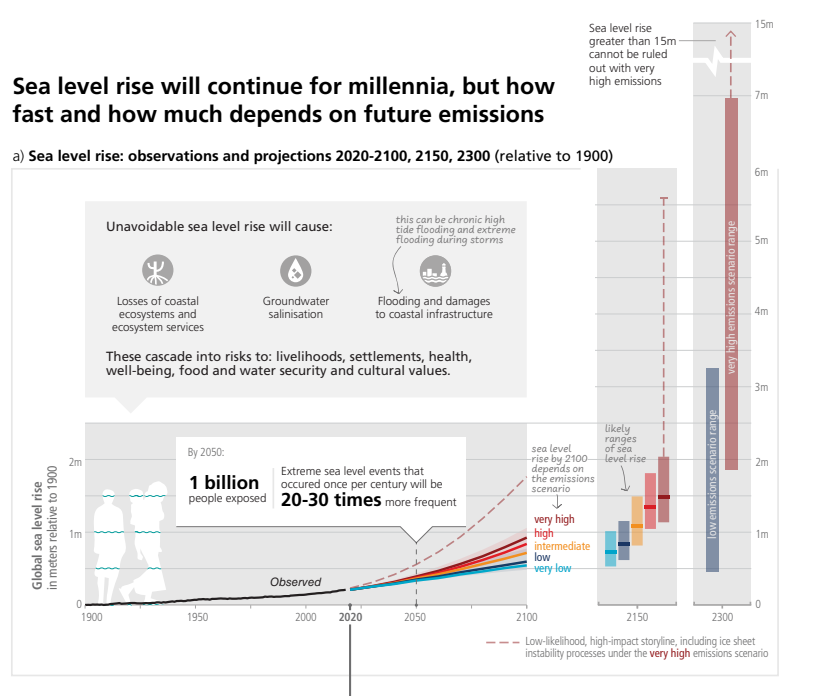
Sea level rise under different emission scenarios and timescales. IPCC 2023 Longer Report, Figure 3.4, p80.

Obviously Valente is writing fiction and is allowed to make things up. The question is why. Why make a world where there is no land, and the humans left need to live only on islands of floating garbage from the before-times? The moral arrow of the story points to an explanation. The virtue of a floating world with no land is that it’s a closed system. We have to learn to make do with what we have. This world of hyper-degrowth and hyper-austerity is beyond even sustainability. Trees can’t come back to replace ship hulls; sails can’t be replaced with canvas from newly grown cotton. Humanity can feed itself fine with seafood, but as the foundations of Garbagetown rot away, in ten or twenty generations of eking out a living, presumably everyone just falls into the sea and dies. This is why Tetley blows up part of Garbagetown – because they were about to waste resources on a futile quest for land, and she is angry that they won’t just conserve and appreciate the beautiful things they have (and then later die). Within the world of the book, she’s totally right. Her reasoning is not from any systematically collected evidence or theory: it’s pure intuition. Or since she was completely right, perhaps we should call it prophecy.

This book was a pick for the Solarpunk reading group, and I see why: Hugo nominee, optimistic protagonist. But it’s actually the most anti-solarpunk novel ever written. There is no hope of building a future of beautiful architecture and technology which supports the harmonious thriving of ecosystems and human societies, even on the other side of catastrophe. It’s an entire society with terminal cancer, and the best they can do is die with grace.

The book’s surface layer is one of tough minded gutter realism, of facing up to tough facts. But this is not at all the planet we ourselves live on. Our planet is not a terminal patient on a cancer ward: it’s a patient in an emergency room. It needs urgent interventions like shutting off coal plants and solar geoengineering, while longer term medicine like changes to healthier lifestyles, energy and social systems, and nurturing of ecosystems back to health, can start to take effect. 

Both Tetley’s optimism and her instinctive thriftiness are survivor instincts. She has been compared to Candide, but she reminds me more of survivors of death camps that hoard every scrap they can find. Valente’s fairy tale projects that grief and trauma onto us. The world is just what it is, the fight is already lost, and the best you can do is live quietly and find the beauty in garbage. It’s beautifully crafted. It’s planetary trauma porn. It’s awful.

Does Anne of Green Gables Dream of Electric Sheep?

Caroline M Yoachim – A Rabbit Egg For Flora 

Adam Berman – Egg Tooth

Philip K Dick – The Preserving Machine

In an early Philip K Dick fairy-tale, an eccentric scientist invents a machine for turning musical pieces into animals. It works quite well, at least when the animals are kept inside, as pets. The animals can be easily converted back into recognizable entries of the classical canon. Yet the point of the project is preservation for the ages, across scores of generations, and when released into the nearby forest, the animals change. Some are eaten. Some turn wild. When the pipe-organ-like machine is used to convert them back, the result is strange, disturbing, sounds, barely classifiable as music at all.

A Rabbit Egg For Flora, by Caroline Yoachim, feels like it is set in one of these PKD worlds, while telling a story that the great man seemingly never could. In The Preserving Machine, for example, the vivid clunking fact of the machine breaks down for the characters, while reality of the world grows for the reader. Character reality frays and reader reality intensifies. Rabbit Egg is not about fraying, but repair. A single parent and her daughter play a game, discovering artificial eggs. It’s Pokémon, but for nanotechnological wonders which restore ecosystems.

“What do you think it will be?”

“Bobcat!”

I laugh. “I don’t think our local ecosystem can support a predator that big.”

“Deer!”

“Lobster!”

The dark-haired boy snorts. “The sea-life expansion got pushed back three months because ocean acidity is still too high.”

Behind the children’s game, this is a world of catastrophic loss. It is perhaps decades or centuries in the future: probably billions of people died as supporting natural systems collapsed around them, before everything finally bottomed out. It is perhaps a few decades on from the dayglo dystopia of Do Androids Dream of Electric Sheep?, where, unlike Blade Runner, Deckard had an obsessive hobby of trying to find pet animals, and where even dogs and cats are so rare they are fabulously expensive. Rabbit Egg, daringly, takes this place as the setting for a charming childhood romance. It’s in a solarpunk collection, and this is the solarpunk gambit, really: envisioning repair instead of doom. Eventually, in Androids, Deckard finds a frog, which he doesn’t recognize is actually a mechanical simulacra. He is always a childlike assassin. You can imagine him enjoying searching for eggs.

Egg Tooth, by Adam Berman, is an uneasy, meticulously crafted, story that doesn’t show its cards early. It could be set in a more orderly, Australian, corner of that same collapsing world, albeit without any androids. If the voice of Rabbit Egg is Anne of Green Gables, the voice of Egg Tooth is clearly Kafka. This is not the cartoon avatar of bureaucratic frustration found in popular culture. (Is it a red tape? Is it a show trial? No – it’s Kafkaman!) This is the baffled observer-protagonist of The Castle or the A Country Doctor, intensely moved, evicted from his own head.

Between the apartments were skyscrapers in varying styles and states of decay. Whereas the oldest buildings tended to be the most complete, more recent projects appeared unfinished, with large black tarps covering jagged upper floors. The older buildings paid their penance in other ways, being covered in higher concentrations of graffiti and torn nylon banner advertisements. 

I am cagey about sharing the details of Egg Tooth, lest I inadvertently pick apart its fine weave. There are plenty of stories about the future being horrible, and they generally don’t interest me. What makes Egg Tooth compelling, and a little sickening, is the implication that among the collapse, this society is a relative success: a place of orderly utilitarian kindness among more general chaos, with famine and death just off-screen.

Both of these stories appear in collections of solarpunk science fiction, though Egg Tooth is by far the glummest boat in the sunny tech nouveau solarpunk regatta. Despite the revolutionary names of solarpunk, or even Extinction Rebellion, green politics is often forced to be conservative, or even reactionary – stop doing this, stop killing that, restore what was good and beautiful and pure. Flora wants rabbits back; in Egg Tooth the platypus may just be saved. Indeed, we need to stop and restore! But this is also why, politically, it’s so easy to slip from green to ecoreactionary; to the idealization of past social and technical forms. (And from there, ecofash is but a short goosestep away.)

Solarpunk is a countermovement of repair. It does not idealize feudal peasant tech and social mores, but puts the technology of the sun in its name. If we need romanticism, well, this is a far better romance. I hope Flora gets her rabbit egg, given she lives in North America, where it is not a pest. But the clever nanites that build the rabbits are also little conservatives, rebuilding what once was. Though both of the stories I’ve talked about here are great, and take risks in their own ways, most solarpunk plays it safe. Solarpunk is usually solarcozy. Quite a lot of it is secretly Egg Tooth wearing sunglasses – the literature of the precautionary principle and managed decline.

Most solarpunk I’ve seen – and much of these two collections – is good at the local, the relational, and the romantic – the Mrs Brown stories of the Turkey City Lexicon. This is a strength where science fiction traditionally had a weakness. It is good to have stories like this. The two stories I’ve named don’t span all of the weird creatures of the subgenre. But I wonder, based on what we’ve seen so far, whether this cozy vision can encompass the radically changed, and the truly planetary.

There are two and a half stories I imagine could only be written if solarpunk writers stopped playing it safe. The half is Fully Automated Planetary Solarpunk, a setting with Green Stack crisis management and universal basic services, which writers like Kim Stanley Robinson have at least had a crack at. The second is a Neo-Edwardian High Tory Solarpunk, with Art Nouveau aesthetics, solar industrialists, plucky aristocratic Indian adventuresses, and imperial confidence in multi-generational stewardship. I have to admit I name this one partly for the joy of the cognitive-political dissonance it implies in a community which can be painfully earnest at times. But beyond that, stories which deal with the age of Dadabhai Naoroji and the first National Parks also ask what it means to wield and abuse power across global networks, to preserve ecosystems, and to valorize traditional and indigenous continuity. The third, often quite incompatibly with the other two, would be a xenofeminist solarpunk, a solarpunk of unprecedented scale, cunning, and vision, a tech-subverting, wilderness-unleashing liberatory force, that like punk, would celebrate the strange, wild things that hatch from future eggs.

A Rabbit Egg For Flora by Caroline M Yoachim is published in Multispecies Cities. Egg Tooth by Adam Berman is published in And Lately, The Sun.