Grief Is Red

Catherynne M. Valente – The Past is Red

EVERY MORNING I wake up to find words painted on my door like toadstools popping up in the night. Today it says NIHILIST in big black letters. That’s not so bad! It’s almost sweet! Big Bargains flumps toward me on her fat seal-belly while I light the wicks on my beeswax door, and we watch them burn together until the word melts away. “I don’t think I’m a nihilist, Big Bargains. Do you?”
She rolls over onto my matchbox stash so that I’ll rub her stomach. Rubbing a seal’s stomach is the opposite of nihilism.

The Past is Red starts with a beautifully direct voice. It’s a young woman’s voice, talking to us in first person, and she’ll be with us for the entire novel, for it’s her story. Tetley, her name is, named after a label on a discarded teabag, and it’s a voice of survivor optimism, the voice of someone finding beauty every day in between episodes of horrible abuse. Tetley is amazing, she finds beauty in garbage, and she lives on a giant floating island of garbage, cobbled together from the future version of the Pacific Garbage Patch. It’s called Garbagetown.

Tetley’s people live on and in Garbagetown because there’s nothing else left after catastrophic climate change. Just garbage and old ships floating atop a world-sized ocean. The rubbish is a serious resource, pragmatically sifted by the residents. They make use of what their predecessors, the Fuckwits – that is, us – threw away. Like the residents of Smokey Mountain, the Manila garbage dump, they have rituals, songs, etiquette, dialects, fashion and social hierarchy. They have a culture.

Tetley is Cinderella, Rapunzel, Cassandra, and a terrorist. The fairy tales come together in a weave that is itself a new fairy tale, not just the execution of a template. As the story progresses, and we learn  about the world, Tetley’s moral and intuitive understanding of the world is repeatedly confirmed. This isn’t really a surprise: she’s the hero.

There is something nihilistic and death-loving about this book. It’s not at all lack of craft: it is beautifully written. It’s not abused, romantic Tetley either. Valente writes she knew this story had a special voice from the first sentence, and I believe that. No, the choice that makes this death-loving is the construction of the world. 

To touch on spoilers, it is an ocean world not just in the sense that the oceans rose and coastal cities were destroyed. In this book everything terrestrial is now underwater – everything except a sad little island a few hundred metres wide, full of memorials. This is also a nearish future setting, where various bits of historical electronics still work, if well maintained and you get lucky. Now, a common very high emission scenario – a scenario where we go backwards on the lukewarm carbon emission progress made since the nineties – has a projected sea level rise of seven metres by the year 2300. Let’s be clear – seven metres is pretty catastrophic. It would flood cities and displace millions or even a billion people. But there’s a hill at the end of my street that’s about fifty metres tall. I live in Brisbane, on the coast, too. Drive 130 km west to Toowoomba and you can get a whole regional city at 690 metres elevation, on the flattest continent on Earth. Even Singapore, a small, flat island hugely vulnerable to sea rise caused by climate change, has Bukit Timah hill, 164 metres tall. The standard science could be wrong by an order of magnitude and bits of Singapore would still be well above the water. Actual serious mountain ranges like the Andes or Himalayas are thousands of metres tall; Everest is over eight kilometres.
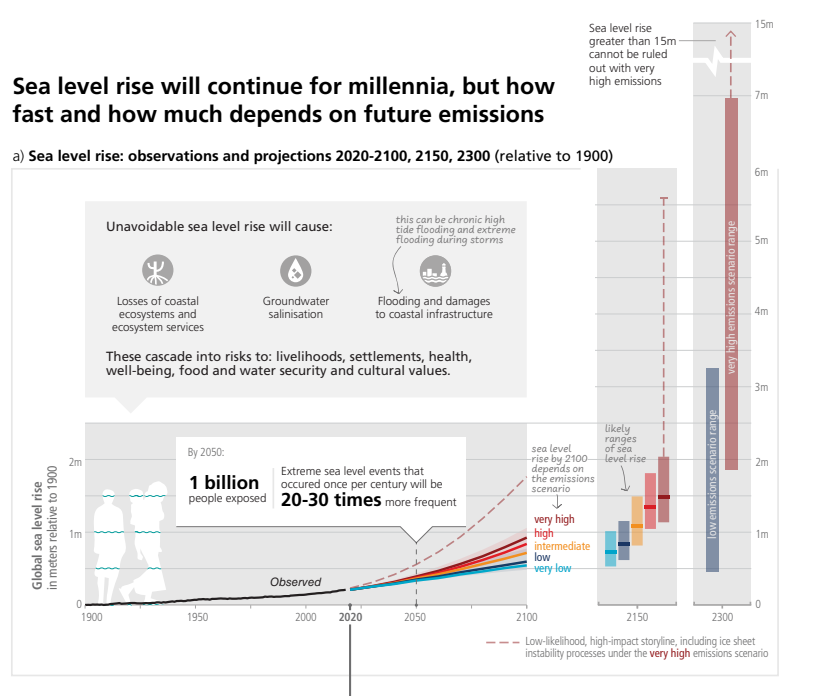
Sea level rise under different emission scenarios and timescales. IPCC 2023 Longer Report, Figure 3.4, p80.

Obviously Valente is writing fiction and is allowed to make things up. The question is why. Why make a world where there is no land, and the humans left need to live only on islands of floating garbage from the before-times? The moral arrow of the story points to an explanation. The virtue of a floating world with no land is that it’s a closed system. We have to learn to make do with what we have. This world of hyper-degrowth and hyper-austerity is beyond even sustainability. Trees can’t come back to replace ship hulls; sails can’t be replaced with canvas from newly grown cotton. Humanity can feed itself fine with seafood, but as the foundations of Garbagetown rot away, in ten or twenty generations of eking out a living, presumably everyone just falls into the sea and dies. This is why Tetley blows up part of Garbagetown – because they were about to waste resources on a futile quest for land, and she is angry that they won’t just conserve and appreciate the beautiful things they have (and then later die). Within the world of the book, she’s totally right. Her reasoning is not from any systematically collected evidence or theory: it’s pure intuition. Or since she was completely right, perhaps we should call it prophecy.

This book was a pick for the Solarpunk reading group, and I see why: Hugo nominee, optimistic protagonist. But it’s actually the most anti-solarpunk novel ever written. There is no hope of building a future of beautiful architecture and technology which supports the harmonious thriving of ecosystems and human societies, even on the other side of catastrophe. It’s an entire society with terminal cancer, and the best they can do is die with grace.

The book’s surface layer is one of tough minded gutter realism, of facing up to tough facts. But this is not at all the planet we ourselves live on. Our planet is not a terminal patient on a cancer ward: it’s a patient in an emergency room. It needs urgent interventions like shutting off coal plants and solar geoengineering, while longer term medicine like changes to healthier lifestyles, energy and social systems, and nurturing of ecosystems back to health, can start to take effect. 

Both Tetley’s optimism and her instinctive thriftiness are survivor instincts. She has been compared to Candide, but she reminds me more of survivors of death camps that hoard every scrap they can find. Valente’s fairy tale projects that grief and trauma onto us. The world is just what it is, the fight is already lost, and the best you can do is live quietly and find the beauty in garbage. It’s beautifully crafted. It’s planetary trauma porn. It’s awful.

Deliberate Anarchy As Climate Governance

It is informative to think about the science of changing climate as two fields. The first is long-term meteorology, making predictions about how the atmosphere and climatic conditions change over long periods of time. This is about a century and a half old and built on physics, chemistry, and observations from a variety of real time and historical sources such as satellites and ice cores. The current dominant paradigm of long-term meteorology includes anthropogenic climate change driven by atmospheric carbon and other gases. It’s a very successful theory whose dominance has been cemented by a track record of new data emerging and anamolies resolving in ways which confirm it. The discovery that satellite measured temperatures were not accounting for relativistic effects caused by the speed of the satellites, and this was causing almost exactly the anomalous difference between ground and satellite temperatures, was one of the more dramatic of these. This was nearly ten years ago. The existence of a handful of outlying dissenting experts outside the paradigm is just confirmation that it’s a real scientific community; the same phenomenon accompanied Newtonian mechanics and the molecular theory in chemistry too. This is reality, as best we can tell.

The second field is political climatology, dealing with the ways a mass of people and their social institutions deal with the climate of the planet they live on. This is a new field at which we are still pretty awful (including attempts by climate scientists). I use the term political climatology deliberately, by analogy with the political economy, ie, economics, and the constraints that politics as a human behaviour places on it. We are pretty bad at the political economy, though we’ve had a few wins over the last century. At political climatology we are just pants.

I don’t just mean we are awful in that we have lousy outcomes, I mean the whole structure of the discussion and the seriousness of institutional design is lacking. The entire debate is in the wrong place. There are interesting arguments within climate science, and there are major and controversial policy decisions to be made. We have a science built on all the sophistication of the Englightenment and the Industrial Revolution, and a monster set of interlinked problems caused by the wondrous success of the same. Meanwhile our toolset for discussing and organizing around it as a society is like five drunk old men with head injury debating the existence of an iPhone.

There is one intellectually tenable policy position which can be shared between someone serious about seeing the world as it is and the fairy land tales of climate fabulists or deniers. That is the policy of deliberate neglect. Accepting the fact of human driven climate change, we choose not to make governments act to remediate it.

Though the changing climate is indeed something to dread and gird ourselves against, the argument goes, any political solution would cause damage too great to our institutions. 

Usually this is framed as economic cost, and people like Jim Manzi argue, contra Stern et al, that the GDP costs of mitigation are simply smaller than the benefits.

There are technical problems with Manzi’s argument: scenario choice is highly selective, and GDP is a lousy basis for century scale prediction. That latter post also suggests in an ecological catastrophe, money may not be everything. (When The Economist suggests you are suffering compulsive quantification disorder and need to sit back and smell the drowning flowers, something is up.) Nevertheless Manzi’s willingness to grapple publicly with scientific reality in arguing policy, something that say, George Monbiot, does routinely from a different political tradition, gets towards the type of debate required.

Climate change is a global problem, and worse than that, a global collective action problem. It’s also larger than a few percent of GDP. In the history of the world, there has been environmental catastrophe, but there has never been democratic world government. Dan Hannan, among others, argues that this is a straightforward function of the distance of the government from individual concerns. It helps to know that Hannan is a ferociously euroskeptic MEP, and has more recently found it convenient to disparage the science without fully disavowing it. Even souveriniste libertarian conviction politicians have bases to mollify, I guess.

The sorry record of corruption and bad policy in global institutions does rather support Hannan’s position, though. Indeed, even the experience of the smaller, transnational, EU supports it – technocratic, with little democratic check, and corrupt to the degree its accounts have not been signed off by an auditor in a dozen years. For those who support a different factional football team, consider the IMF, or the WTO. And as beautiful as the vision of the United Nations is, the power there is with the Security Council, a standing committee of Great Powers and their proxies. 

This is not a screed about UN black helicopters and mind control rays. We simply need to be clear-eyed about the state of our global political institutions before we hand them the Earth’s thermostat. This is especially since decades of dithering makes geoengineering more likely, or necessary.

Some (say, certain large, industrial, non-democracies) may  take the utilitarian line that political niceties are a luxury in the face of catastrophe – a case of give me liberty and give me megadeath. And certainly geophysics doesn’t care about politics. However, the argument for ecofascism is not only rather odious in itself, but highly centralised government has an appalling environmental record. Capitalism and democracy have their environmental failures, but communism is the most toxic pollutant man has yet devised. Contrast the Cuyahoga River and the Aral Sea. 

The environment, in this argument, is too important to be passed off to a global bureaucracy to create a Common Fisheries Policy for carbon. Human nature and its politics will not change any time soon. Better for liberty and ecosystems alike that nations remain in productive mutual anarchy.

That is not my position – this note is a way of thinking through the problem. There are other approaches. The world almost tried one with Kyoto-Copenhagen. Tech can change faster than human nature, and different social contexts allow it different expression. Deliberate anarchy is credible enough to be the benchmark. We can easily do worse. Can we do better?

花雨从天来 /已有空乐好 – 李白:寻山僧不遇作

A light rain fell as if it were flowers falling from the sky, making a music of its own – Li Bai, Looking For A Monk And Not Finding Him, Allen trans.