Mass Gentrification

You can sit in a building in West Coast Park in Singapore and get a reasonably clear view of America.

On one side, you can find a drive-thru fast food vendor with a full carpark, selling fries and burgers. On the other, you see a cafe nestled in the trees of one of the largest and nicest parks in the city.

Both are branches of an American multinational. The cafe food and coffee is tasty enough for a franchise; it’s easy to get worse food at more expense. The burgers are fresh.

Look right: Red state. Look left: Blue state. HBO / Fox. New York / Dallas. Thesis / antithesis.

Now, not only are these two eateries under the same roof, but they’re actually the same company – McDonald’s, and its McCafe offspring. (How it achieved a pocket monopoly with no neighbouring hawker centre is another question.)

When McDonald’s was founded, people mostly got paid to exercise. There were more blue collar, manual jobs. Cheap meat, from the first wave of agricultural mass production, was a welcome boon. Now we get paid to sit still at an office, and incomes have increased to a point where, in a rich or middle income country, it is easy to be poor and fat. It’s so easy it’s rather undesirable and déclassé – hence the backlash against fast food brands in recent years. Books and films like Fast Food Nation are as much passive economic data points as active shifters of public opinion. The threat of regulation shouldn’t be discounted, but is itself only made possible by a cultural shift.

So the popular palette has shifted, and a corporation that likes profit has shifted to match it. This hasn’t just happened on the cafe side, either. They have, for instance, healthier Happy Meals – same insidious toy hook, apple pieces instead of fries. Premium options are always good for businesses like McDonald’s with large rent and labour costs relative to the cost of their food. In the past this is why upsizing was useful. Now that leaves us terrified of being giant tubs of heart-seizuring lard, you have options like the Mighty Angus Burger, which is a more expensive cut of meat. “It’s a little bit fancy,” the Australian ad campaign runs.

Posh things have got cheaper and are more widely consumed. So cheap you can buy them at McDonald’s. This is now widespread. It’s almost the entire business model of Starbucks and Gucci. This was not so clearly the case during our journey from the Industrial Revolution. Things were often cheap and standard but not as nice as the craftware they replaced – at least what little you could afford. (Social poshness is a relative good and as scarce as ever.) 

This is not an original observation, though the scale of it is, mayhaps, not appreciated enough. Marx, Schumpeter, or any economic historian could tell you about it. I asked an economist for the short technical name for it, and he replied “capitalism”.

Amusing as that is, capitalism drove price drops and standardization as much as it drove the current push to quality. I prefer the term mass gentrification. The process of luxurious unattainables becoming commodities.

For all the recent chatter of capitalism being destroyed by its own contradictions, I’m not quite sold. It has a history of transcending them.

“Are you having the thesis or the antithesis?” I asked, as my wife returned to the table at one tentacle of global McCapitalism. “The synthesis,” she said. “And it’s good.”

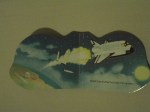
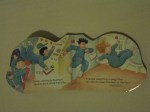
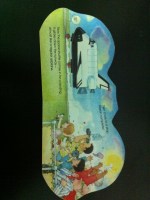
Farewell, Space Shuttle

This book was given to my son by his grandmother a year or two ago. It was bought second-hand at a church stall. Still seem to be other second hand copies around online.

Farewell.

VIII.9 Made to follow a path

子日,民可使由之,不可使知之。– 论语 八:九

The Master said, ‘The common people can be made to follow a path but not to understand it.’ — Analects VIII.9 (Lau)

The Analects is addressed to students of government from an aristocratic class (君子, gentlemen). Confucian Software is addressed to software developers, and the fundamental analogy is that the audience is the same: Confucius instructing software developers on becoming gentlemen and sages.

So the differences between gentlemen and the common people are important. We should distinguish the gentleman (who is educated) from the people (who are not) and the small man (小人) who has no understanding or respect. (See Analects XVI:1.)

At first glance this passage is Confucius at his most snobbish and feudal. The people, or the common people (民), can only be driven down a path and are devoid of thought and understanding. This is the same word now used in the People’s Republic of China (中华人民共和国), the word democracy (民主) or all of Sun Yat-sen’s (孙中山) three principles of the people (三民主义). So it can be rather off putting for we moderns.

Indeed, it sounds more like the brutally effective carrot and stick of Lord Shang (商鞅) and the Legalists (法家) than gentle old teacher Kongzi. Passages like this show how the Han dynasty could create the political philosophy of Imperial Confucianism (as John King Fairbank terms it) – the fusion of a Confucian public morality with the real-politikal techniques of Legalism to run the sausage factory of government. The Legalists found just how far you could push realpolitik without public morality when the common people revolted and overthrew the short-lived Qin dynasty (秦朝), which established the Chinese empire, but could not make it endure.

The relationship of the developer to her users via code is that of the scholar official to the people via the bureaucracy. It is also isomorphic to the GUI model view controller pattern.

People Scholar Bureaucracy – Model View Controller

Users walk a path laid out by the code, and beyond a certain point, can take no other.

The code too can be made to follow a path, when we constrain and verify that a path is followed. This is the purpose of testing, to ensure deterministic repeatability. Without testing, there is no engineered path. There is just walking.

When we anthropomorphize software by describing it as thinking, it means we do not have sufficient control on its internals and environment. (By calling the people code we are automatomorphising people as much as we are anthropomorphizing code.) Code cannot think. Once thinking creatures are built on code we should no longer deal with them as code.

Can users be made to think (know, understand)? Ah, you laugh! Feudalism is not so dead after all.

Code certainly cannot be made to think. Nothing can be made to think. And this is also the more generous interpretation of Confucius’ intent. You cannot make the common people  understand a path, you can only lead them to understanding. The meaning of a software system is generated by this interaction.

The Mall

This is not one of 50 Posts About Cyborgs, but it owes much to the series.

The mall is a cybernetic garden at the crossroads of suburbia. It exists as a reconstructed island of metropolitan density in an environment hostile to it. Suburban houses are on a relatively human scale, but suburbia is not. Suburbia in the large is the domain of the automobile.

The city and the mall are cybernetic in that they are self-regulating human structures which take on environmental management in a way that makes it unconscious to users. The mall air conditioning is a clue. With cybernetics we change our environment; as cyborgs we change ourselves.

An informative exercise for those wanting to discover this island of density is to cross a shopping mall car park by foot on a summer’s day. It is striking what a brutally awkward space it is. It is at the intersection of car and person, hostile to both.

The most excellent mall entrance from a carpark I have seen is at Suntec City Plaza in Singapore. As in many Brisbane shopping centres, the underground carpark leads into a large stairwell for the escalators up into the main set of shops. At Suntec City they have expanded the space and included a massive pond. Large Chinese goldfish and carp swish through the water, easing the stress of bustling and queueing that is mall and carpark existence. Small waterfalls provide white noise cover for engines revving in low gear downstairs and muzak upstairs. The water garden of lilypads and shrubs scrub the air of exhaust fumes. The glass of the automatic doors reflect the tranquility into an imaginary middle distance. Fish ponds are not unusual in Singapore, but the enervating context makes this one an underground Hanging Garden of Babylon.

I have more affection for the entrance than the rest of Suntec City, which is otherwise a graceless sprawl of one way escalators and cavernous halls segregated from the metro system (until very recently). It is a confusing space, twisty but without organic paths of use, where assistants have to be paid to accompany the standing maps, as a rescue service for beleaguered shoppers.

More common is placing a mall above an MRT station. Crossroads are common precursors to markets. The intersection of needs is already in place.

City is a recurring suffix for malls in Singapore – Great World City, Turf City, Vivo City – which is a curious intensifying suffix to use in a country which is already a city-state. City in Chinese is 城市, literally a wall plus a market. A mall, too, is that.

To conclude, or perhaps, to make manifest:

The city is a self-regulating human modification for surviving hostile environments.

The mall is a type of internal city which attempts to modify humans to survive the hostile environments of cities.

The inner city and the outer suburbs can both be hostile environments.

Where the city itself is a savannah for metropolitan cyborgs, the mall-spaceship can be dismantled.

The natural environment of man is yet to be built.
John Powers

Alexander Hamilton likes this

Iceland is using Facebook as a town hall medium in rewriting its constitution. This – mass collaboration a common draft – is much closer to wiki-constitutionalism than the original example of successive strongmen rewriting from scratch. Facebook does lack the ability to propagate rapid minor version updates. On the other hand it plugs into the social fabric with an almost disturbing ease, making the political discussion a natural outgrowth of relationships in the polity.

Rewriting from scratch, with a mass referenda signoff, is if anything analogous to broadcast media. It’s the end of season cliffhanger where all the characters wake up to discover it was all a dream.  (Noticed by John.)