Deliberate Anarchy As Climate Governance

It is informative to think about the science of changing climate as two fields. The first is long-term meteorology, making predictions about how the atmosphere and climatic conditions change over long periods of time. This is about a century and a half old and built on physics, chemistry, and observations from a variety of real time and historical sources such as satellites and ice cores. The current dominant paradigm of long-term meteorology includes anthropogenic climate change driven by atmospheric carbon and other gases. It’s a very successful theory whose dominance has been cemented by a track record of new data emerging and anamolies resolving in ways which confirm it. The discovery that satellite measured temperatures were not accounting for relativistic effects caused by the speed of the satellites, and this was causing almost exactly the anomalous difference between ground and satellite temperatures, was one of the more dramatic of these. This was nearly ten years ago. The existence of a handful of outlying dissenting experts outside the paradigm is just confirmation that it’s a real scientific community; the same phenomenon accompanied Newtonian mechanics and the molecular theory in chemistry too. This is reality, as best we can tell.

The second field is political climatology, dealing with the ways a mass of people and their social institutions deal with the climate of the planet they live on. This is a new field at which we are still pretty awful (including attempts by climate scientists). I use the term political climatology deliberately, by analogy with the political economy, ie, economics, and the constraints that politics as a human behaviour places on it. We are pretty bad at the political economy, though we’ve had a few wins over the last century. At political climatology we are just pants.

I don’t just mean we are awful in that we have lousy outcomes, I mean the whole structure of the discussion and the seriousness of institutional design is lacking. The entire debate is in the wrong place. There are interesting arguments within climate science, and there are major and controversial policy decisions to be made. We have a science built on all the sophistication of the Englightenment and the Industrial Revolution, and a monster set of interlinked problems caused by the wondrous success of the same. Meanwhile our toolset for discussing and organizing around it as a society is like five drunk old men with head injury debating the existence of an iPhone.

There is one intellectually tenable policy position which can be shared between someone serious about seeing the world as it is and the fairy land tales of climate fabulists or deniers. That is the policy of deliberate neglect. Accepting the fact of human driven climate change, we choose not to make governments act to remediate it.

Though the changing climate is indeed something to dread and gird ourselves against, the argument goes, any political solution would cause damage too great to our institutions. 

Usually this is framed as economic cost, and people like Jim Manzi argue, contra Stern et al, that the GDP costs of mitigation are simply smaller than the benefits.

There are technical problems with Manzi’s argument: scenario choice is highly selective, and GDP is a lousy basis for century scale prediction. That latter post also suggests in an ecological catastrophe, money may not be everything. (When The Economist suggests you are suffering compulsive quantification disorder and need to sit back and smell the drowning flowers, something is up.) Nevertheless Manzi’s willingness to grapple publicly with scientific reality in arguing policy, something that say, George Monbiot, does routinely from a different political tradition, gets towards the type of debate required.

Climate change is a global problem, and worse than that, a global collective action problem. It’s also larger than a few percent of GDP. In the history of the world, there has been environmental catastrophe, but there has never been democratic world government. Dan Hannan, among others, argues that this is a straightforward function of the distance of the government from individual concerns. It helps to know that Hannan is a ferociously euroskeptic MEP, and has more recently found it convenient to disparage the science without fully disavowing it. Even souveriniste libertarian conviction politicians have bases to mollify, I guess.

The sorry record of corruption and bad policy in global institutions does rather support Hannan’s position, though. Indeed, even the experience of the smaller, transnational, EU supports it – technocratic, with little democratic check, and corrupt to the degree its accounts have not been signed off by an auditor in a dozen years. For those who support a different factional football team, consider the IMF, or the WTO. And as beautiful as the vision of the United Nations is, the power there is with the Security Council, a standing committee of Great Powers and their proxies. 

This is not a screed about UN black helicopters and mind control rays. We simply need to be clear-eyed about the state of our global political institutions before we hand them the Earth’s thermostat. This is especially since decades of dithering makes geoengineering more likely, or necessary.

Some (say, certain large, industrial, non-democracies) may  take the utilitarian line that political niceties are a luxury in the face of catastrophe – a case of give me liberty and give me megadeath. And certainly geophysics doesn’t care about politics. However, the argument for ecofascism is not only rather odious in itself, but highly centralised government has an appalling environmental record. Capitalism and democracy have their environmental failures, but communism is the most toxic pollutant man has yet devised. Contrast the Cuyahoga River and the Aral Sea. 

The environment, in this argument, is too important to be passed off to a global bureaucracy to create a Common Fisheries Policy for carbon. Human nature and its politics will not change any time soon. Better for liberty and ecosystems alike that nations remain in productive mutual anarchy.

That is not my position – this note is a way of thinking through the problem. There are other approaches. The world almost tried one with Kyoto-Copenhagen. Tech can change faster than human nature, and different social contexts allow it different expression. Deliberate anarchy is credible enough to be the benchmark. We can easily do worse. Can we do better?

花雨从天来 /已有空乐好 – 李白:寻山僧不遇作

A light rain fell as if it were flowers falling from the sky, making a music of its own – Li Bai, Looking For A Monk And Not Finding Him, Allen trans.

Mass Gentrification

You can sit in a building in West Coast Park in Singapore and get a reasonably clear view of America.

On one side, you can find a drive-thru fast food vendor with a full carpark, selling fries and burgers. On the other, you see a cafe nestled in the trees of one of the largest and nicest parks in the city.

Both are branches of an American multinational. The cafe food and coffee is tasty enough for a franchise; it’s easy to get worse food at more expense. The burgers are fresh.

Look right: Red state. Look left: Blue state. HBO / Fox. New York / Dallas. Thesis / antithesis.

Now, not only are these two eateries under the same roof, but they’re actually the same company – McDonald’s, and its McCafe offspring. (How it achieved a pocket monopoly with no neighbouring hawker centre is another question.)

When McDonald’s was founded, people mostly got paid to exercise. There were more blue collar, manual jobs. Cheap meat, from the first wave of agricultural mass production, was a welcome boon. Now we get paid to sit still at an office, and incomes have increased to a point where, in a rich or middle income country, it is easy to be poor and fat. It’s so easy it’s rather undesirable and déclassé – hence the backlash against fast food brands in recent years. Books and films like Fast Food Nation are as much passive economic data points as active shifters of public opinion. The threat of regulation shouldn’t be discounted, but is itself only made possible by a cultural shift.

So the popular palette has shifted, and a corporation that likes profit has shifted to match it. This hasn’t just happened on the cafe side, either. They have, for instance, healthier Happy Meals – same insidious toy hook, apple pieces instead of fries. Premium options are always good for businesses like McDonald’s with large rent and labour costs relative to the cost of their food. In the past this is why upsizing was useful. Now that leaves us terrified of being giant tubs of heart-seizuring lard, you have options like the Mighty Angus Burger, which is a more expensive cut of meat. “It’s a little bit fancy,” the Australian ad campaign runs.

Posh things have got cheaper and are more widely consumed. So cheap you can buy them at McDonald’s. This is now widespread. It’s almost the entire business model of Starbucks and Gucci. This was not so clearly the case during our journey from the Industrial Revolution. Things were often cheap and standard but not as nice as the craftware they replaced – at least what little you could afford. (Social poshness is a relative good and as scarce as ever.) 

This is not an original observation, though the scale of it is, mayhaps, not appreciated enough. Marx, Schumpeter, or any economic historian could tell you about it. I asked an economist for the short technical name for it, and he replied “capitalism”.

Amusing as that is, capitalism drove price drops and standardization as much as it drove the current push to quality. I prefer the term mass gentrification. The process of luxurious unattainables becoming commodities.

For all the recent chatter of capitalism being destroyed by its own contradictions, I’m not quite sold. It has a history of transcending them.

“Are you having the thesis or the antithesis?” I asked, as my wife returned to the table at one tentacle of global McCapitalism. “The synthesis,” she said. “And it’s good.”

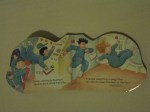
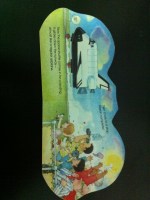
Farewell, Space Shuttle

This book was given to my son by his grandmother a year or two ago. It was bought second-hand at a church stall. Still seem to be other second hand copies around online.

Farewell.

VIII.9 Made to follow a path

子日,民可使由之,不可使知之。– 论语 八:九

The Master said, ‘The common people can be made to follow a path but not to understand it.’ — Analects VIII.9 (Lau)

The Analects is addressed to students of government from an aristocratic class (君子, gentlemen). Confucian Software is addressed to software developers, and the fundamental analogy is that the audience is the same: Confucius instructing software developers on becoming gentlemen and sages.

So the differences between gentlemen and the common people are important. We should distinguish the gentleman (who is educated) from the people (who are not) and the small man (小人) who has no understanding or respect. (See Analects XVI:1.)

At first glance this passage is Confucius at his most snobbish and feudal. The people, or the common people (民), can only be driven down a path and are devoid of thought and understanding. This is the same word now used in the People’s Republic of China (中华人民共和国), the word democracy (民主) or all of Sun Yat-sen’s (孙中山) three principles of the people (三民主义). So it can be rather off putting for we moderns.

Indeed, it sounds more like the brutally effective carrot and stick of Lord Shang (商鞅) and the Legalists (法家) than gentle old teacher Kongzi. Passages like this show how the Han dynasty could create the political philosophy of Imperial Confucianism (as John King Fairbank terms it) – the fusion of a Confucian public morality with the real-politikal techniques of Legalism to run the sausage factory of government. The Legalists found just how far you could push realpolitik without public morality when the common people revolted and overthrew the short-lived Qin dynasty (秦朝), which established the Chinese empire, but could not make it endure.

The relationship of the developer to her users via code is that of the scholar official to the people via the bureaucracy. It is also isomorphic to the GUI model view controller pattern.

People Scholar Bureaucracy – Model View Controller

Users walk a path laid out by the code, and beyond a certain point, can take no other.

The code too can be made to follow a path, when we constrain and verify that a path is followed. This is the purpose of testing, to ensure deterministic repeatability. Without testing, there is no engineered path. There is just walking.

When we anthropomorphize software by describing it as thinking, it means we do not have sufficient control on its internals and environment. (By calling the people code we are automatomorphising people as much as we are anthropomorphizing code.) Code cannot think. Once thinking creatures are built on code we should no longer deal with them as code.

Can users be made to think (know, understand)? Ah, you laugh! Feudalism is not so dead after all.

Code certainly cannot be made to think. Nothing can be made to think. And this is also the more generous interpretation of Confucius’ intent. You cannot make the common people  understand a path, you can only lead them to understanding. The meaning of a software system is generated by this interaction.

The Mall

This is not one of 50 Posts About Cyborgs, but it owes much to the series.

The mall is a cybernetic garden at the crossroads of suburbia. It exists as a reconstructed island of metropolitan density in an environment hostile to it. Suburban houses are on a relatively human scale, but suburbia is not. Suburbia in the large is the domain of the automobile.

The city and the mall are cybernetic in that they are self-regulating human structures which take on environmental management in a way that makes it unconscious to users. The mall air conditioning is a clue. With cybernetics we change our environment; as cyborgs we change ourselves.

An informative exercise for those wanting to discover this island of density is to cross a shopping mall car park by foot on a summer’s day. It is striking what a brutally awkward space it is. It is at the intersection of car and person, hostile to both.

The most excellent mall entrance from a carpark I have seen is at Suntec City Plaza in Singapore. As in many Brisbane shopping centres, the underground carpark leads into a large stairwell for the escalators up into the main set of shops. At Suntec City they have expanded the space and included a massive pond. Large Chinese goldfish and carp swish through the water, easing the stress of bustling and queueing that is mall and carpark existence. Small waterfalls provide white noise cover for engines revving in low gear downstairs and muzak upstairs. The water garden of lilypads and shrubs scrub the air of exhaust fumes. The glass of the automatic doors reflect the tranquility into an imaginary middle distance. Fish ponds are not unusual in Singapore, but the enervating context makes this one an underground Hanging Garden of Babylon.

I have more affection for the entrance than the rest of Suntec City, which is otherwise a graceless sprawl of one way escalators and cavernous halls segregated from the metro system (until very recently). It is a confusing space, twisty but without organic paths of use, where assistants have to be paid to accompany the standing maps, as a rescue service for beleaguered shoppers.

More common is placing a mall above an MRT station. Crossroads are common precursors to markets. The intersection of needs is already in place.

City is a recurring suffix for malls in Singapore – Great World City, Turf City, Vivo City – which is a curious intensifying suffix to use in a country which is already a city-state. City in Chinese is 城市, literally a wall plus a market. A mall, too, is that.

To conclude, or perhaps, to make manifest:

The city is a self-regulating human modification for surviving hostile environments.

The mall is a type of internal city which attempts to modify humans to survive the hostile environments of cities.

The inner city and the outer suburbs can both be hostile environments.

Where the city itself is a savannah for metropolitan cyborgs, the mall-spaceship can be dismantled.

The natural environment of man is yet to be built.
John Powers