VII.14 The joys of music

子在齐闻韶,三月不知肉味,日,不图为乐之至于斯也。– 论语,七:十四

The Master heard the shao in Ch’i and for three months did not notice the taste of the meat he ate. He said, ‘I never dreamt that the joys of music could reach such heights.’ — Analects VII.14 (Lau)

When Ataturk said “There is no revolution without music,” he had a very specific type of music in mind. The founder of modern Turkey had already brought and led the country through extraordinary change, from wars through ways to dress through the structure of government. At least in Andrew Mango’s interpretation, adoption of the European classical music tradition could then stand as a culmination of that national modernization, a sign that Turkey had arrived.

For Confucius, too, music had moral and political weight as well as aesthetic. Harmony was of great importance to him as a political theorist and as a system designer. Different components work together in harmonious co-operation in a well-built system. Confucius saw a well-functioning state working the same way: for example in XII.11, when everyone from the ruler on knows their place in the system, they can work together.

Carol Michaelson and Neil Macgregor link Confucius’ sense of harmony with the grand bronze ceremonial bells of the Spring and Autumn Period 春秋时代. These were large, expensive, technically sophisticated objects, only within the reach of a lord of a state. We can even imagine this institutional sound being the rather austere music Confucius so enjoyed, though it could have equally been zithers and pan pipes on a more intimate scale.

It’s a very personal, visceral, human reaction captured here, with senses overwhelmed by an aesthetic experience. It shows this reaction to the harmony of a system – a system of instruments in this case – as an intuitive one. It’s also a refined sense. Confucius is, amongst other things, a music critic and a censor, as in XV.11, where he says “Banish the tunes of Cheng” 放郑声远.

This intuitive, trained, sense of how a system is assembled is of great value to a software developer. Kent Beck used the term Code Smell to refer to the sense something could be improved in a piece of software, based on a relatively short aquaintance with the code. Confucians have an auditory metaphor, rather than an olfactory one, but the idea of aesthetic cues for system building coming from non-conscious sources is the same. Code smells focus on the dischordant elements. Conversely, code can sing. The fix is in, everything compiles without warnings, the unit tests and acceptance tests are green, you deploy and run cleanly in production; the joys of software can reach such heights.

[B]elatedly we need to tell you that the musical ensemble would have been a happier mataphor[.] — DeMarco and Lister, Peopleware
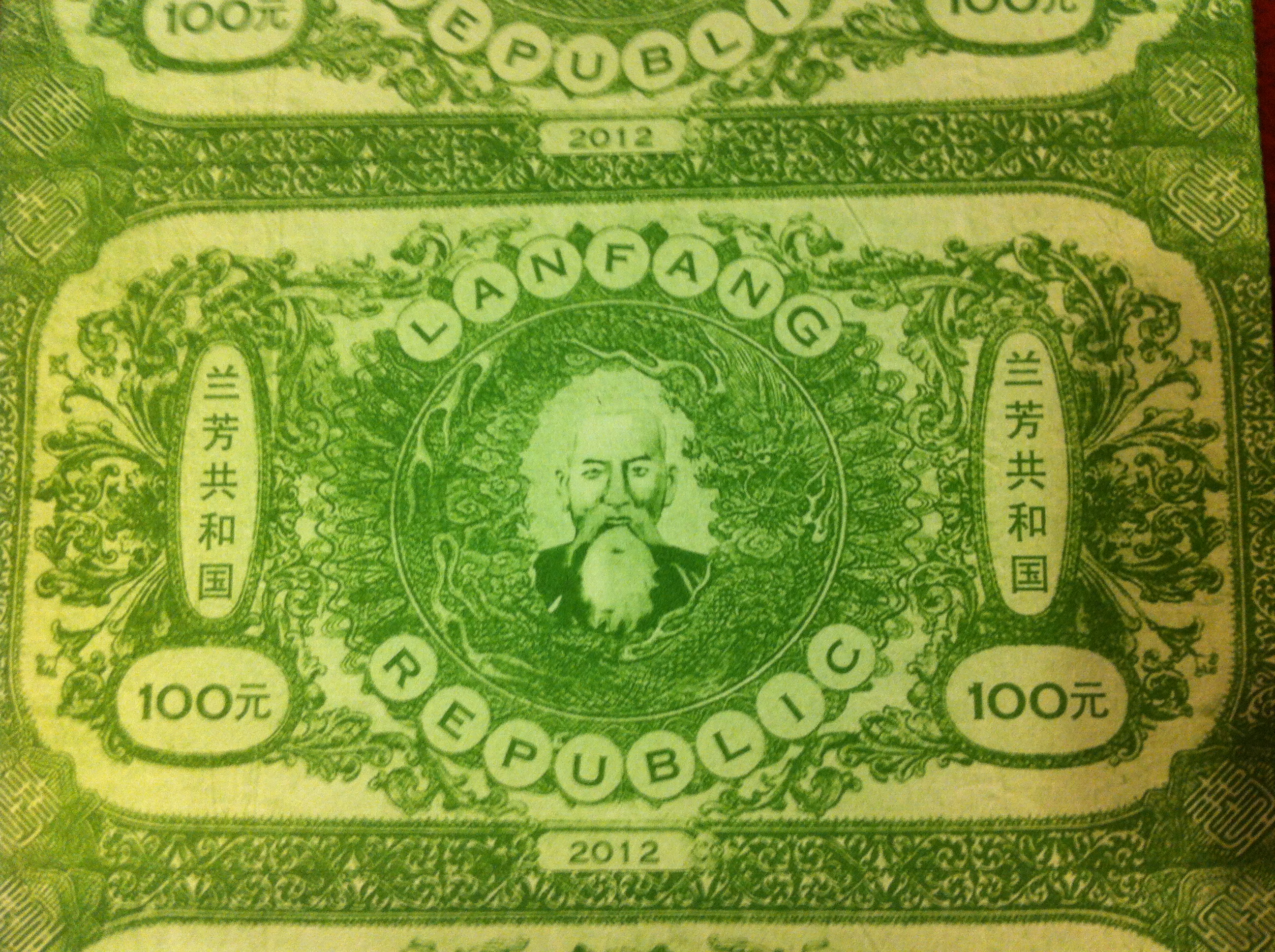
Nostromos of Nanyang

All history is political, and all history is suffused with a sense of loss. 兰芳记, The Chronicles of Lanfang, sifts through both. Working with a team of writers and performers, director Choy Ka Fai brings into being a speculative museum of the Republic of Lanfang (兰芳公司), an 18th-19th century Hakka Chinese settlement in what is now Indonesian Borneo. The piece can be explored as a museum site alone, and there are also performed tours of the museum.

The Lanfang Republic was a real place, and there is a serious argument to consider it a small state with a population of tens or hundreds of thousands of people, depending on the time, and how you count. (For example, the wikipedia page points out only ethnic Chinese had voting rights in presidential elections. Without disputing major race discrimination was going on, the territory of the republic was probably not clearly controlled at borders in the modern sense, either.) The settlement existed because of, and the economy was dominated by, a nearby gold mine. It’s a fascinating moment in time, and the musuem setup includes archival material and books like Yuan Bingling’s intriguingly titled Chinese Democracies for those that want to follow up further.

The exhibits, and the performances, hold up artifacts to the light for us to see. This ranges from historical, to speculative, to impossible-but-thematic. A photo of a Chinese merchants Dayak wife, and her son; with a note that Dayak women were bought with a dowry. As well as conventional monogamy and traditional multi-wife polygamy, the massive gender disparity on the gold fields also spawned other relationships: like multiple miners pooling their funds to match the scarce erotic capital of a single Dayak wife, who would be free to sleep with other men or buy her way out of the marriage.

The speculative De Groot Collection organizes reconstructed artifacts into a museum tour. The curator/actor relates a timeline around the artifacts linking it to more familiar events in consensus history like the Napoleonic Wars or the abdication of Qianlong 乾隆帝. There’s a beautiful momentum to Ng Yi-sheng’s speech, though the inclusion of Luo Fang Bo’s mythical crocodile harnesses in the collection derailed it slightly for me. Choy Ka Fai is interested in obscured history, he tells us in the performance prologue, but undersignalled mythology obscures it further.

The short documentaries, The Man Who Rode Crocodiles, and Insignificant Landscapes, are meditations on emptiness and ruin, using locations tied to the republic. This whole piece isn’t just about the history, or else it would be a museum exhibit. The films are more about showing an absence, which is harder than it sounds.

A small number of artifacts, like the banknote at the top of the post, are from a parallel present that never existed. I have a weakness for these. They taunt me to see if I can pay with Luofang yuan (LFY) when booking tickets for the upcoming test match between the Confederate States of America and the Republic of Kashmir.

Parts of this piece have been staged once before at the Singapore Art Musuem, but it is sited now at the Ying Fo Fui Kun Cemetry 应和会馆墓. It’s an evocative place, founded by Hakka from the same Chinese prefecture as those that founded Lanfang Kongsi, three years later. Two short solo performances make a great theatrical use of the space. Epic Poems of the Kongsi War, in the form of a Malay family history, has a particular strength. The explicit performances give the actors the freedom to use full hysterical throttle as required. For the more curatorial pieces, it’s harder to strike the appropriate tone. This isn’t Banksy upending institutional hypocrisy with postmodern untruth, after all, unless I’ve misread the intent entirely. To reveal obscured history, I wonder if it might have been simpler to get a grad student from one of the local history departments involved as a guide, if harder to coach for a broad audience.

These are minor points. I spent the afternoon exploring the remnants of a republic founded a year after the United States declared independence, with the population of classical Athens, that lasted for a hundred years, but was convenient for people to forget. The study of the classics, Mary Beard recently wrote, is the study of what happens in the gap between antiquity and ourselves. Sometimes antiquity happens very quickly.

The Washington Consensus As Climate Governance

A whisper of global government already exists. We don’t call it that, usually, unless we happen to be conspiracy theorists talking about UN black helicopters. Our experience of the all-encompassing modern state makes the fragile spiderwebs of global institutions seem unfamiliar. 

The world government – a framework of agreed action through laws and common permanent forums –  is there, though. It’s found in pretty much the places you might expect – the United Nations, the International Monetary Fund, the World Bank, or the World Trade Organization. Political theorists need to make fine distinctions between global confederation and other forms of government, but when almost every nation is in the club, lines begin to blur.

In this familiar list of institutions, all but one were designed and driven to creation by Cordell Hull’s State Department in the flurry of institution building at the end of WWII. This is not to discount the role of other nations in this multilateral process, but it required extraordinary circumstances, and a new superpower, to bring them to the table.

The exception is the World Trade Organization, which took fifty painstaking, special interest-coddling years to come into being. As an example of the problem, the WTO is an effort to promulgate a Washington Consensus of free trade, but no Washington administration thought it could really commit to it when it came to free trade for its welfare-queen farmers. And the US was by no means unique in this regard, with Japan and continental Europe (later the EU) in the same position.

The Washington Consensus method for climate governance is like the construction of the WTO, or the European Union: get everyone from everywhere in a big room and marinate them in money and compromise until enough people are ready to sign what they were all taught at politician school was a pretty good idea in the first place. (WTO is reheated Ricardo and supra-national republican government is reheated Kant.) Kyoto is fourteen years old and deep in the same sort of diplomatic sausage mince GATT was in for half a century.

In other words, this solution is the solution we’ve been trying for a while now. It has some advantages. The incessant talking and committees are a conflict management technique, the idea being that people talking aren’t shooting one another. This is well and good, but an approach which relies on the benefits of inaction isn’t going to have much near term impact on a problem of industrial and economic inertia. There is always going to be some governments who see national advantage in derailing any more radical change than slow consensus.

My prediction is that we will not have any serious multilateral regulation of carbon, say through a World Climate Organization, before 2050. It and the Kyoto process may be part of the ongoing management of the climate, eventually,  but they won’t be a solution to the current industrial and economic design problem. We’ll be up to our ankles in cholera flavoured glacial melt and ecosystem failure by then. 

Al Gore’s right to say politics can be non-linear: but not in this forum. Solving climate governance with the Washington Consensus would, like the UN,  require a pre-eminent superpower focusing a group of allies on the issue; a climatological Coalition of the Willing. If Kyoto was going to fix climate change, it would have done so by now. It’s a needed process, but solutions lie elsewhere.

Etiquette, Transparency and Defaults

I’ve been having a retro-private, offline discussion with John on Girls Around Me, which has now erupted into the blogosphere. John summarizes the setup and pushes public data. 

These sorts of apps are part of the future, and it’s not all bad. Stross is also right, but he’s right in a science-fictional way – no doubt a professional hazard. Public data can be a good but I can’t get away from an ethical intuition that this data is the wrong shape. It’s a glass building that bakes its occupants at midday.

I’m really glad that at least some people using this are making a deliberate, empowered choice to make their data public because they like the benefits and are comfortable with the risks. That’s tops. You go, young gendered person.

One aspect bugging me is the discounting of defaults that has gone with the transparent school of responses. As we know, pretty much everyone follows the defaults except a few unusually committed users. This is what libertarian paternalism is all about. It’s a well recognized phenomenon in usability.

Facebook and foursquare certainly have ethical obligations around their default settings, and they are systematically failing to think through them. Their model is too crude and it invites blowback. If it really is generational, as John suggests, they should cue based on age. If it’s geographic, by place. That doesn’t even start to address the one identity aspect. Walt Whitman wouldn’t have been welcome on Facebook. He contained multitudes.

Lastly, the app itself is a problem. The transparent society is well and good but the Girls Around Me app violated a key part of it. Its asymmetry was rude. The etiquette of a transparent society as Brin envisages it is tilted against the voyeur. It’s far more embarrassing to be spying on your neighbour’s bedroom than anything he may be doing in there. The crassness of this app is its fatal flaw, precisely because the social norms are new and not well established. It’s the loser at the topless beach ogling breasts with his tongue hanging out. If the app had required you to be signed in and broadcasting your identity on Facebook and foursquare – and perhaps had more variety in its objectification of women – it would rightly not have been seen as so threatening. ((All avatars are objectifications.)) 

Even by new, transparent, social conventions, Facebook, Foursquare and especially the app are cads, sir. Cads.

XII.11 Let the prince be a prince 

Duke Ching of Ch’i asked Confucius about government. Confucius answered, ‘Let the ruler be a ruler, the subject a subject, the father a father, the son a son.’ The Duke said, ‘Splendid! Truly, if the ruler be not a ruler, the subject not a subject, the father not a father, the son not a son, then even if there be grain, would I get to eat it?’ — Analects XII.11 (Lau)

齐景公问政于孔子。孔子对日,君,君,臣,臣,父,父,孑,子。公日,善哉,信如君不君,臣不臣,父不父,子不子,虽有粟,吾得而食诸。- 论语,十二:十一

This is one of The Analects clearest statements of the feudal and patriarchal social order that would later get the name Confucianism. Detach it, for a moment, from that overwhelming cultural context, and it’s also an expression on separating design concerns. The two can be contrasted. Every political pundit is a social engineer. They either advocate improvement to the design of the state, or argue a change will break the existing system.

Mencius (孟子) expanded on this sentiment for one of the earliest recorded defenses of the division of labour (Book 3 part 1 chapter 4, 3-4). Labour specialization works because humans have limits on the complexity of a task they can undertake, and are not cloneable or particularly fungible. 

Software, by contrast, is highly specialized, but also cloneable at near zero cost. Software complexity has different boundaries. There are physical limits inherent to what Harrison Ainsworth calls engineering in a computational material. These are physical characteristics of algorithmic complexity or computability – limits on how fast a particular problem can be solved, if it can be solved at all. 

There are, by contrast, few physical limits to the conceptual complexity of a software component. Those measures like cyclomatic complexity – number of subtasks, variables and choices in a method – have high values, orders of magnitude short of the physical limits imposed by compilers and interpreters. (I once worked on a system where other team members had, in their wisdom, exceeded the limit for the size of a single Java method in a long list of simple business transformation rules. Pushed by the very essence of the language to refactor, they proceeded to – what else? – push the remaining rules into longMethod2().)

The limits which measures like cyclomatic complexity indicate are human limits. They mark the soft edges of a space where humans can effectively create, manage, or even understand software. There are different ways of describing coding conventions, but they all seek to indicate a limit beyond which code becomes illegible.

Legibility is the term James C. Scott uses to describe the social engineering needs of a nascent or established state (Seeing Like A State). The mechanics of a working state require internal legibility. Those working for it must be able to measure and understand their environment in mutually compatible terms which also promote the success of the government. This is why feudal states have such a profusion of titles which become the name of the person (not Bob – The Duke of Marlborough). It is also why courtly dress has such systematic rules. This is seen particularly in bureaucratic feudal states as seen historically in East Asia, eg in feudal Korea, but also in the Vatican, or the badges at the postmodern World Economic Forum. These codes serve the dual purpose of defining the interfaces of the state and of making the role of the person instantly legible to one familiar with the system, all while tempting people with the markings of social status.

Marking lexemes by colour and shape according to their role is exactly what IDE pretty printing achieves. This is also the intent behind decoupling, encapsulation, and well-named entities (name oriented software). It makes the role of a component, from lexical to method, class and class pattern levels, readily legible to humans who much maintain and extend the system. 

This strictness of role works well for machines made of non-sentient digital components. For systems where components are sentient meat, there are inevitable side effects. This is, perhaps, the core ethical dilemma Confucius concerns himself with: the demands of The State and The Way (道).

FUNCTIONS SHOULD DO ONE THING. THEY SHOULD DO IT WELL. THEY SHOULD DO IT ONLY. — Robert Martin, Clean Code