The Spines of Usury

It was ’97. We were out east near the Cambodian border, knee deep in melting baht and desperation. Every morning we dug the mindworms out of our imported Canadian breakfast cereal and threw them in the camp recycling bucket, and we thought we were doing it pretty tough. We were a bunch of chump accounting grads, Asian studies majors and rag-tag thaumaturgists. The IMF sent us, though they hid our budget under a line item for car parking or reports on stochastic models of dam finance costs adjusting for GDP on normalized time scales, or some such thing. We were their economic psychics, the frontline team sent in when things got rough.

The people out there had it pretty bad that summer. They were copping a heck of a psychic backlash, all those loans and deals and pacts broken, all those prayers gone awry and financial gearboxes thrown into reverse. The folks out east are serious Buddhists so their karmic buffers were usually strong, but too many surprises and a massive currency devaluation take their toll on anyone.

We’d been going hard at it for a few weeks, trying to balance ledgers and keep the local monks onside. What we called the camp was really a sprawling two storey Thai hotel on the outskirts of town, depressingly cheap to book out in its entirety for as long as the team was there. That afternoon I had gone up the small mountain nearby with the diviners. It was a national park, and approaching the peak was a mix of temple ruins from the many Siamese wars, topped by two or three more contemporary TV broadcast towers. The ley lines were fantastic up there, and we were picking up a lot of crisis metrics that way. When I got back in the evening Dave threw the paper down in front of me while I was spooning up Pad Thai. We’d usually read the FT – great horoscopes – but this was one of the many local papers, tabloid headlines and lurid photographs of car accidents and celebrities. There on page five was an unfortunate woman impaled on a kind of spear. She was a shopkeeper from a nearby town.

“Not really the local gangster style,” I said.
“Look closer,” said Dave. “Look close at the shaft.”
After a while I saw something. There were a series of fine decorations all along the shaft, like small strands of rope, or thick hair.
I looked at Dave expectantly until it was clear to him I had no idea.
“Fucking manticores,” he said.

Our agreement with the local monks, combined with our own internal regulations, meant our rules of engagement allowed for the following equipment: 1 notebook, 2 blue pens and 2 red pens, 1 pocket calculator, 1 large bottle of water, 1 copy of the Diamond Sutra and 1 personally significant religious symbol, politely displayed or concealed. Our early research had indicated ghosts as a big risk. All the sources still say it is a major ectoplasmic hotspot, but I only saw one ghost the whole time I was there. He was an eight foot tall purple man with a machete stuck through his chest. He gave me a sheepish wave and that was the last I saw of him.

I was working with a farmer, Mr Koichai Rattanathunat, who lived on the edge of town. He ran a pretty big operation, and was pretty rich for the area, or he had been. He had taken out some commercial loans with a local bank that got most of its funding from the international bond market. It had been a bad season, and a couple of weasel clauses and a few mills of rat’s blood in the contracts meant he was effectively USD funded. Suddenly one morning he went from profitable to six feet underwater.

The first sign I had of the repo man was the ceiling of the house imploding inwards. It was a twelve foot manticore, with black Oakley sunglasses stretched across its broad, garbage can lid face, and built like a brick shithouse with wings. It strolled across the open living / office area, reaching out casually with its front left paw to slap me in the chest and send me flying across the room into the wall. It walked on up to Mr Rattanathunat and fired seven short spines, hand length, into his face and chest. He was meat at that point. Poisoned meat, what’s more.

The manticore strolled over to the back door and muttered something in guttural accented Thai my way. I didn’t catch anything except “foreigner” and that he’d dropped the polite “khap” at the end of the sentence. Then the manticore smashed through the door and flew off.

We had some paladins in the department, but they were all being seconded to Interkarmapol in Bangkok. They were dealing with the vampire problems that always come with any big global turnout, be it crisis, G7 meeting, or whatever. I’m sure it all seemed pretty serious from their side, but I read the reports later and it was mostly anticoagulant and mood lighting. Meanwhile we were getting the shit kicked out of us and small businesses were dropping like flies.

Now I don’t rightly know that Dan Cobb was the one solved our manticore problem. I did get to see him in action once, though, right about that time.

Sammy Chan was actually from Laos, but had stuck with his Han-derived surname when he migrated around the time of the Indochina war. He ran one of those Thai cowboy ranches, where businessmen who’ve watched too many dubbed John Wayne movies come up from Bangkok to ride horses and chew tobacco for a week. It had done a good trade for a few years but now all the bookings had dried up and cancelled overnight. The saddles, bridles and hats were all imported from the US as well. Sam was at a point where it was not so much deciding whether to shut up shop as when, and how much of a mess it would make. I had gone out there for a few days, and over the course of it Sam confided in me that some of his less savvy ancestors had run up heck of a credit card debt on the gold Visa cards he’d burnt for them during the boom. Dan turned up around lunchtime on the second day, asking if he could help out.

We sat out on the verandah of the otherwise empty saloon bar Sammy had set up there, bringing Dan up to speed on the situation, but also running off on a few conversational tangents, grim and resigned by turns. The bar overlooked the ring where chubby rice salesmen had so recently taken turns on patient, but not too patient, imported horses. In some ways the tangents were the most important part of the conversation for Sammy. He knew this business was gone, at least for a while. He needed new ideas most of all, and while Dan didn’t have any business plans to hand over, he always had interesting angles on events.

We were pretty deep in this conversation when I saw the bat-winged shadow flit across the rodeo ring. I tackled Sammy to the floor as a four foot spine thudded into the wooden post behind us. I looked back to check if Dan was ok, and he had already taken cover at the edge of the bar. He moved fast for such a big man and must have seen the monster before I did.

Sammy groaned and clutched at his chest. I was thinking I’d cracked his rib or given him a heart attack or something when he rolled over cleanly and pulled a god-damned 13 inch silver plated Colt revolver out of his jacket. He started to wave it towards me, still confused by what was going on, though I noticed he hadn’t cocked it yet. I looked pointedly out over the ring where the manticore was swooping by for another pass, and another spine shot just over my head, like a flash of lightning in a summer cloud.

She had streaming blonde-brown hair, this manticore, and she grinned the beautiful smile of the predator pouncing on its prey. I dived behind a hastily upended table. It was a difficult angle, with the long awnings of the verandah, but she was happy to toy with us from an unreachable distance, as she fired some short spines into the table, splintering half of it into uselessness. Sammy let off a shot. It zinged into the sky without even touching her leather and Kevlar vest. Nevertheless, a new look of seriousness fixed itself on her face and she flew up out of visibility as Sammy let off another shot. Damn it Sammy, I thought, if you were packing, couldn’t you have carried an Uzi?

I ran to a new position behind another table while wondering if I could be any more useless. Sammy also shifted around, then went back to stillness. I’d lost track of Dan. I wondered if he’d gone for help. I breathed. We waited.

The manticore, when she came back it was in a screaming dive bomb where she pulled up just enough to skim off the table we were originally at, crash through the tables in the centre and land at the open space near the entrance, slowly spinning and firing hand-length spines all the way. Just before landing, though, where she would have been facing us, ready, she somehow crumpled. She landed on her right legs and they rolled underneath her, and instead of stopping in an alert crouch, she slid through like a motorbike accident and her neck hit the doorway with a sickening crack. She didn’t move after that.

We walked up, on guard, but she was dead. A pen had stuck deep into her left nostril, all the way into her brain. Dan must have thrown it somehow as she made her charge.

The pen was green. Dan Cobb never was much of one for following the rules.

Soon after that, the manticores stopped hassling people. I figure Dan did more than his share.

You know I heard Dan Cobb once beat Tim Geithner at tennis left handed. They played at one of those hotel courts in Hong Kong, twelve stories up, on a bad smog day. Geithner broke back a few times, but he went down in straight sets.

Hamilton’s Counter-Sketch At The Philadelphia Design Review

Comparisons of the US Constitution to software design are fairly commonplace. A pattern-focused one by Howard Dierking appears in a recent book on Open Government, but it goes back at least to the dot-com era and probably before. The analogies have their limitations, such as a tendency to foreground the machinery of government and background the people in politics, and the reasons they might push a given position. That said, I certainly dabbled in it myself during the wild analogy-soaked amusements of my youth; and as a system which is human centric, statically defined and with key properties only obvious at runtime, thinking about government is not such a bad training for software design.

Whatever the merits of the full metaphor, I don’t think it’s a stretch to describe the Philadelphia convention itself as a design process. I was struck by Hamilton’s role as described by Ron Chernow. The design meeting was a bit thinly attended. Of the fifty-five on the invite list, only thirty were actually there most of the time, with people drifting in and out, and a number of invitees considering it not particularly important in their busy working lives. The discussion itself happened behind closed doors, with an agreement for the debate to stay between delegates, to allow the sharing of different design ideas.

At the time of the convention, as Americans who stayed awake in civics class probably already know, the United States was organized on the basis of the Articles of Confederation, which loosely grouped the former colonies together on terms weaker in some ways than the current European Union. The US government was unable to reliably raise tax revenue, for example, and as a result still held massive debts from the Revolutionary War, including soldiers’ pay.

The convention had so far been dominated by a proposal from Madison and the Virginia delegation for a much stronger national government, of two legislative houses, proportional to population, a President and a Supreme Court. William Paterson of New Jersey argued for revisions to the Articles that fixed some problems in the confederation but retained its minimalist character. Three weeks in, constructive discussion had begun to stall, with delegates forming factions around the two plans. Hamilton, relatively young but hardly unknown, had uncharacteristically spoken little during the convention so far, and didn’t favour either plan. Chernow relates:

It was predictable than when the wordy Hamilton broke silence, he would do so at epic length. Faced with a deadlock between large and small states, he decided to broach a more radical plan.On Monday morning, June 18, the thirty-two-year-old prodigy rose first on the convention floor and in the stifling, poorly ventilated room he spoke and spoke and spoke. Before the day was through, he had given a six-hour speech (no break for lunch) that was brilliant, courageous, and, in retrospect, completely daft. He admitted to the assembly that he would adumbrate a plan that did not reflect popular opinion.
[…]
His mind had minted an entire program for a new government, not just scattered aspects of it.
[…]
He now suggested a president and Senate that would be elected but would serve for life “on good behaviour”. Hamilton’s chief executive differed from a monarch in that he would be elected and, if he misbehaved, subject to recall. […] While Hamilton’s Senate would be chosen for life by electors [ie like the historical Electoral College -CA], his House of Representatives, by contrast, was exceedingly democratic, chosen directly by universal male suffrage every three years. Thus, the aristocratic element would be represented by the Senate, the common folk by the House. As prosperity widened income differentials in future years, Hamilton feared that the Senate and House might try to impose their wills on each other: “Give all the power to the many, they will oppress the few. Give all power to the few, they will oppress the many.”
[…]
To curb further abuse, Hamilton recommended a Supreme Court that would consist of twelve judges holding lifetime offices on good behaviour. In this manner, each branch would maintain a salutary distance from popular passions. The House of Representatives would be the striking exception. Hamilton concluded, “The principle chiefly intended to be established is this – that there must be a permanent will.”
— Ron Chernow, Alexander Hamilton

There is no definitive record of the plan, but some describe it as abolishing the states, with state governors appointed by the central government. It owed much to the structure of 18th century British government, to the point where it is sometimes called the British Plan.

Chernow goes on to ask “How had Hamilton blundered into this speech?”

Oh Ron, you’re a great biographer, but you’re so wrong about this. Yes, it caused him a great deal of political grief later on. Yes, it didn’t get many votes at the convention. Maybe you could even blame it for derailing his run at the Presidency. But I’ve been in that sort of design meeting. And it needed Hamilton’s crazy design sketch like a thirsty runner needs water.

Hamilton was a designer of systems, and as a system it made sense. William Samuel Johnson said it was “praised by everybody [but] … supported by none”. The debate was becoming entrenched, after which problem solving stops. The size of the meeting would have already been awkward for genuine design conversation. (Its notable that the full convention basically did little but choose among solutions proposed by smaller groups). The Hamilton plan showed some of the dimensions along which the design could meaningfully vary, without simply being an attempt to average the two major proposals on the table. Whenever he incorporates a controversial ingredient of the rival plans, he turns the dial to 11: not just a democratic lower house, a lower house elected every year by every man! Not just an executive: a President-for-life, who he even calls a monarch! Not just a Supreme Court: a dozen Supreme justices! For life!

Often there is a dialectical dynamic in problem solving. I doubt it is as universal as Soviet systems of dialectical materialism for engineers would have it, but the mental procession of thesis, antithesis and synthesis happens often enough to be useful. You can even see it expressed in code sometimes, as two theories of how core concepts in a system should be expressed, fighting it out in marching ranks of source source control commits.

Hamilton showed one synthesis: a way the plans could be modified and still work as systems. Chernow mentions some scholars argue it also worked politically, by being a more radically central government than the Virginia Plan, making it seem moderate by comparison. The eventual solution, the Connecticut Compromise from Roger Sherman, varied along similar axes as Hamilton’s plan, of the composition of the two houses and the nature of the Presidency.

It’s also nice that once the ultimate plan was adopted, Hamilton sent a number of meaty patches in the first milestone of the new system, and didn’t go off and fork the codebase. The merge conflicts from that can be hell.

Dodgy Steve’s Software Manifestagogo

We have totally nailed better ways of developing software by drinking beer and talking about it. This incontrovergitibly shows you should choose:

Beer over processes and tools
Beer over comprehensive documentation
Beer over contract negotiation
Beer over following a plan.

That is, while there is value in the items on the right, we value the items on the left more.

We also really feel like a kebab.

Financialism

Something has been bugging me about John Lanchester’s followup to his very clear and accessible overview of the banking crisis in the LRB. His second piece, Let’s Consider Kate, is rather less satisfying.

The Other

The central argument becomes an analogy between an example of household finances (Kate) and the operation of a large bank. Yet one of the great lessons of economics is that money and production behave differently at great scale. Take Keynes’ paradox of thrift: an individual will need to rein in spending in a time of reduced income to avoid penury, but when everyone in an economy including the government itself is doing it, it compounds the pain. The government, having a different relationship to money and inflation, can act to reduce the pain for everyone and return the economy to overall growth by enduring debt and stoking inflation in bad times (up to a point). Likewise Ricardo’s comparative advantage, likewise Milton Friedman’s points on the velocity of money and the role of inflation – they all operate at scale, not at the kitchen table. A large bank also operates at scale and is intimately connected to the creation of money – perhaps it might work a bit differently too. Isn’t this true of most great ideas – that they do not cleanly fit our folk intuitions?

The natural accompaniment of such puppet show characterization is a hand-waving oversimplification. So we colour in one-third of the banking system in dark colours and call it Other. It’s not that raising equity requirements to proposed Basel III levels, if that’s the suggestion, is even a bad idea. It’s that kitchen table economics doesn’t scale, any more than kitchen table physics scales to describe nuclear fusion inside the Sun; and we need something more sophisticated than kitchen table Financialism to fix it.

My whole point about this system is not that it is a misrepresentation of some Oriental essence — in which I do not for a moment believe — but that it operates, as representations usually do, for a purpose, according to a tendency, in a specific historical, intellectual, and even economic setting. — Edward W. Said, Orientalism

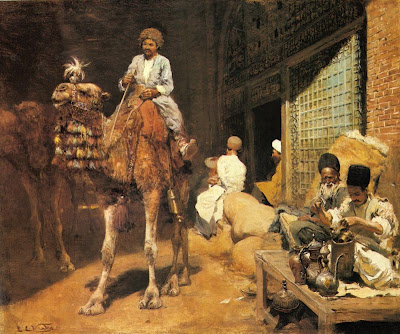
A Marketplace in Ispahan - Edwin Lord Weeks. 1885

The Marketplace

The Nobility of Software Development

Confucians represent one of the earliest groups of knowledge workers in human history. They were trained in specialized knowledge for specialized tasks in a complex society, and they had a sense that their specialized knowledge made them an elite group in society. — Marc Hamann

Software development is both meritocratic and social. In the short and thoughtful note above, Marc Hamann argues this makes the thoughts of Confucius particularly relevant to the endeavour.

Marc well describes the sense of recognition I first felt when reading The Analects, the curiosity and respect for people that underlie this jumble of quotes from Confucius and his disciples. He also describes the disconnect between the brittle hierarchies of Confucianism in its most ossified form and the conservative anti-manifesto at its heart.

He also draws a contrast between the trope of the scruffy, arrogant hacker and the gentlemen 君子 in The Analects. Could we instead imagine a kind of nobility to software development? It would imply a sophisticated engagement and sense of duty to society that is the very opposite of the cliched antisocial developer who cares for nothing but code.

Nobility implies privilege and institutionally supported power as well, of course. But software development already has that. Software is pervasive within most social institutions – civil government, banks, the military, manufacturing, energy production, publishing, movies. It’s embedded in the way we communicate with one another and record our personal histories. And the job of software development is embedded along with it. Citizen programmers have jobs in all these places, vote, own houses, and are thoroughly woven into the social fabric.

The scruffy hacker avant-garde exists, and maybe its a breeder for technical innovation, sometimes. But it’s also a mask for hiding behind, and avoiding responsibility, as argued by historians of technology like Leo Marx.

It’s hard to escape that trope without alternatives. Steve Jobs and Bill Gates provide two: the first not scruffy, rigorous in his focus on usable design, the second for his philanthropic ambition. Their fabulous wealth limits our ability to emulate them. Perhaps someone like Confucius, with his respectfulness and humanism, his thoughts on working as part of a flawed system, can offer another model.